
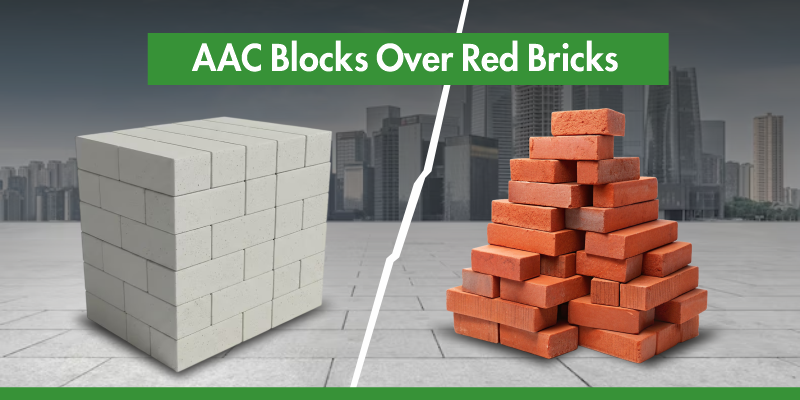
Red bricks have been the default walling material in India for over a century. They are familiar. Every mason knows how to lay them. They are available in almost every town and city.
But familiarity is not the same as being the best option. And over the last five years, builders across India have started running the numbers properly. Not just the cost per brick, but the cost per completed wall. Not just the material price, but what that material does to the steel requirement, the labour time, the plaster consumption, and the project timeline.
When you look at it that way, the gap between red bricks and AAC blocks becomes very clear. This guide covers exactly why builders are making that switch, with verified data from 2025 and 2026.
The Shift From Material Cost to System Cost
For years, the conversation about building materials started and ended with the per-unit price. A red brick costs Rs. 4 to Rs. 12 per piece. An AAC block costs Rs. 45 to Rs. 110 per piece, depending on size. On that comparison alone, bricks look cheaper.
But that comparison is incomplete. It is the cost of one unit. It is not the cost of building a wall.
When you calculate system cost, which includes the material, the mortar, the plaster, the labour, the time, and the structural impact on steel and foundations, the picture changes. One AAC block covers the area of 8 to 12 red bricks. That means fewer units to procure, transport, handle, and lay. Less mortar because the joint is 2 to 3mm instead of 12 to 15mm. Less plaster because the surface is dimensionally accurate. And a lighter wall that reduces dead load on the structure, which directly reduces how much steel and concrete the foundation needs.
The shift happening in Indian construction in 2025 and 2026 is not about builders suddenly preferring a more expensive product. It is about builders finally doing the full calculation.There is a second driver. Labour. Skilled brick masons are harder to find and more expensive than they were five years ago. India faces a growing shortage of construction labour, and the trades that require the most skill and the most man-hours per square metre are the ones that most affect project budgets. AAC blocks need less skilled labour per wall because the blocks are larger, more precise, and faster to lay. A mason laying AAC blocks covers 20 to 25 square metres per day, compared to 12 to 15 square metres with brick.. On a 50,000 square foot residential project, that difference is significant.
The Real Cost Comparison Between Red Bricks and AAC Blocks in 2026
The table below shows what the cost comparison actually looks like when all factors are counted, not just the per-unit price.
| Parameter | Red Clay Bricks | AAC Blocks |
| Unit price (2025) | Rs. 4 to Rs. 7 per piece | Rs. 45 to Rs. 110 per piece (size dependent) |
| Units per sq. metre of wall | Approx. 55 to 65 units at 115mm thickness | Approx. 8 units at 200mm thickness. One block replaces 8 to 12 bricks |
| Wall cost per sq. ft. | Rs. 30 to Rs. 45 approx. | Rs. 40 to Rs. 60 approx. (higher material, lower labour) |
| Mortar joint thickness | 12 to 15mm. High mortar consumption. | 2 to 3mm thin-bed mortar. Uses 3x less mortar volume. |
| Plaster thickness needed | 18 to 20mm external. 12 to 15mm internal. | 12 to 15mm external. 8 to 10mm internal. |
| Mason’s productivity per day | 12 to 15 sq. metres | 20 to 25 sq. metres |
| Dead load on the structure | 1800 to 2000 kg per cubic metre | 550 to 650 kg per cubic metre. Up to 65% lighter. |
| Thermal conductivity | 0.60 to 0.90 W/mK | 0.24 to 0.30 W/mK. Keeps rooms 3 to 5 degrees cooler. |
| Water absorption | Up to 20% by mass (IS 1077) | Max 10% by mass (IS 2185 Part 3) |
| Green certification support | None. Kiln firing contributes to emissions. | Supports IGBC, GRIHA, LEED certification. |
| Fire resistance | Moderate. Dense brick handles heat but mortar joints fail early. | 4 hours at 100mm thickness. Non-combustible. |
The table above covers the primary parameters. For a more detailed technical breakdown including compressive strength testing, seismic zone performance, and region-specific recommendations, the AAC Block comparison covers all of it.